
Technical SEO for Ecommerce
Your store might have great products and strong content, but if search engines can’t properly crawl, index, and render your pages, none of it shows up in search results. Technical SEO fixes the foundation so everything else you do actually works.
20% of product pages weren’t being indexed. Fixed within 3 weeks.
246% organic traffic growth for a Shopify fashion brand.
68% increase in organic revenue for a WooCommerce health store.
Why technical SEO can’t wait
Google can’t rank pages it can’t find
You have hundreds or thousands of product pages, but a surprising number of them aren’t in Google’s index at all. Crawl blocks, broken canonicals, orphaned URLs, misconfigured robots directives. If Google can’t access your pages, they don’t exist in search results. No amount of content or link building fixes that.
Slow pages cost you sales and rankings
Every second of load time matters. Product pages loaded with high-resolution images, third-party scripts, and unoptimized code drive up bounce rates and push you down in search results. Google’s Core Web Vitals are a ranking factor, and most ecommerce stores fail at least one metric. The stores that fix this see both ranking improvements and higher conversion rates.
Platform defaults aren’t optimized for SEO
Shopify, WooCommerce, Magento, and BigCommerce all ship with technical SEO limitations baked in. Duplicate URLs from variant pages, thin collection pages, pagination issues, auto-generated canonical tags that point to the wrong place. Your platform’s out-of-the-box configuration is designed for speed to market, not for search performance.
What technical SEO for ecommerce covers
Technical SEO is the structural work that makes your store visible, crawlable, and fast. Without it, content strategy and link building are built on a broken foundation. Here are the six areas I focus on for every ecommerce engagement.
Crawlability and indexation
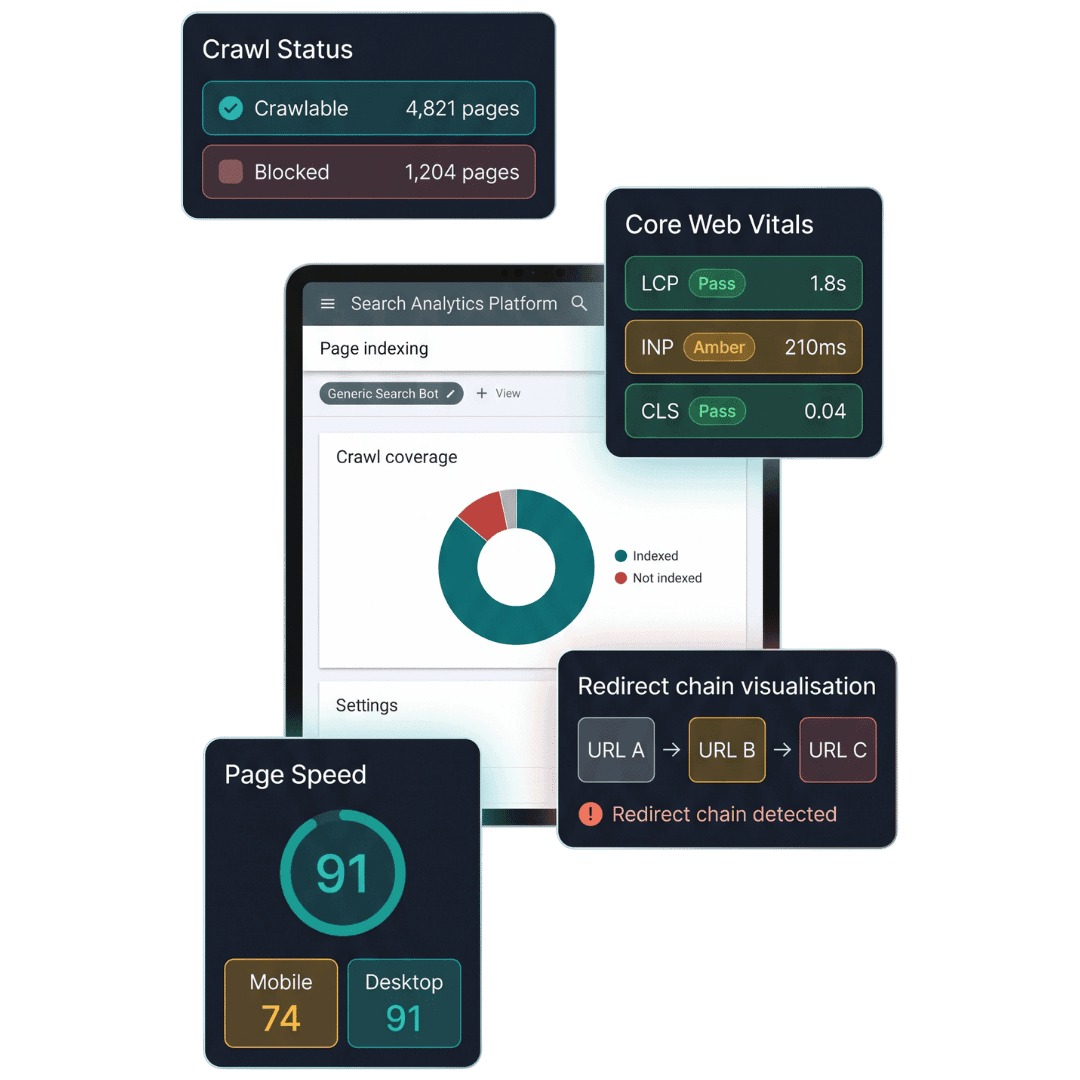
If Google can’t crawl your pages, they can’t rank. I audit everything that affects how search engines access your store: robots.txt configuration, XML sitemap accuracy, crawl budget management, redirect chains, orphaned pages, and indexation status in Google Search Console. For large stores, crawl efficiency determines how much of your catalog Google actually sees.
Site architecture and internal linking
How your pages are organized and connected determines how search engines understand your store’s hierarchy. Category structures, subcategory depth, product-to-category relationships, breadcrumb paths, and cross-linking between related products. A flat, logical architecture with strong internal linking distributes ranking authority where it matters most: your money pages.
Page speed and Core Web Vitals
Slow product pages lose sales. They also lose rankings. I help optimize the factors that affect load time for ecommerce specifically: image compression and lazy loading, render-blocking JavaScript and CSS, third-party script auditing (reviews, chat widgets, tracking pixels), server response times, and Largest Contentful Paint on image-heavy product pages. The goal is green Core Web Vitals scores across your key landing pages.
Structured data for ecommerce
Product schema, review schema, breadcrumb schema, FAQ schema, and organization schema. Structured data helps Google understand what your pages are and display rich results in search, including product prices, availability, star ratings, and breadcrumb trails. Most ecommerce stores either have no structured data or have it implemented incorrectly. I audit what’s there, fix what’s broken, and add what’s missing.
Faceted navigation and duplicate content
This is where ecommerce technical SEO gets complicated. Filters for size, color, price, brand, and material can generate thousands of near-identical URLs that dilute your crawl budget and create duplicate content issues. I configure how these filter URLs are handled: which ones should be indexed, which should be canonicalised, which should be blocked from crawling entirely, and how to do it without breaking the user experience.
Platform-specific technical fixes
Every ecommerce platform has its own set of technical SEO quirks that need targeted solutions. Shopify’s automatically generated collection URLs and limited robots.txt control. WooCommerce’s reliance on plugins that can conflict and bloat page load times. Magento’s complex layered navigation and default URL structures. BigCommerce’s handling of product variants and category URLs. I work within each platform’s architecture rather than fighting against it.
The output is a technically sound store that search engines can crawl efficiently, index completely, and rank confidently. Every fix is prioritized by its impact on organic revenue, not by arbitrary severity scores from a crawl tool.
How it works
01
Technical Audit
Every engagement starts with a technical audit of your store. I crawl the site, review Google Search Console data, assess Core Web Vitals, and identify every issue affecting your store’s ability to get indexed and rank. You get a prioritized list of what needs fixing and why each item matters.
02
Action plan
Not every technical issue has the same impact. I prioritise fixes based on what will move the needle for organic revenue. Critical crawl and indexation problems first, then page speed, then structured data, then ongoing maintenance items. You know what’s being done and why.
03
Implementation
Every fix comes with a detailed brief your developer can act on immediately. No vague recommendations: specific instructions and a clear priority order. I stay involved through the process, reviewing completed work and flagging anything that needs adjusting before it goes live.
04
Monitoring
Technical SEO isn’t a one-time job. Product additions, platform updates, plugin changes, and seasonal campaigns can all introduce new issues. I monitor crawl health, indexation status, and Core Web Vitals on an ongoing basis and catch problems before they affect rankings.
Who this is for
Technical SEO work is most valuable for stores where the technical foundation is actively holding back organic performance. It’s not for every store at every stage.
This is right for you if:
This probably isn’t right for you if:
Related services
Technical SEO is the foundation. These services build on it.
Ecommerce
SEO Audit
Not sure where your technical issues stand relative to everything else? An audit gives you the full picture across content gaps, competitor positioning, and keyword opportunities before committing to any specific service.
Ecommerce
Content Strategy
Once the technical foundation is solid, content strategy fills the gaps. Optimized product pages, category page copy, and supporting content that targets the commercial keywords your customers search for.
Ecommerce
Link Building
A technically sound store with strong content still needs backlinks to compete. Link building strengthens your domain authority and pushes product and category pages higher in results. No PBNs, no spam. Real links from real sites.
Technical SEO work is platform-specific. Shopify, WooCommerce, Magento, BigCommerce: every fix is tailored to your platform’s architecture and constraints.
Frequently asked questions
Ready to fix your store’s technical foundation?
Book your free ecommerce SEO audit. You’ll get a clear view of the technical issues affecting your store’s organic performance and a prioritized plan to fix them.
Typically responds within 24 hours.