
International Ecommerce SEO
Selling internationally means ranking internationally. International ecommerce SEO gets your store visible in the markets you’re expanding into, with the right site structure, localized content, and technical setup to rank in each country without cannibalising your primary market.
65% increase in US organic traffic for a UK-based outdoor cooking brand.
246% organic traffic growth for a Shopify fashion brand.
68% increase in organic revenue for a WooCommerce health store.
Why international expansion stalls in organic search
Translating your site doesn’t localize it for search
You translated your product pages and expected traffic to follow. But direct translations often miss how local customers actually search. “Sneakers” in the US becomes “trainers” in the UK, and what ranks well in one market can have almost no volume in another. Buying behavior, content expectations, and even which search engines people use all differ by market. Getting the terminology right is just the start. A translated site is not a localized site.
You launched in a new market but organic traffic there is flat
The store is live. Products are listed. Maybe you’ve even run paid ads to get initial traction. But organic search in the new market delivers almost nothing. The problem is usually structural: Google doesn’t know which version of your store to show in which country, your new market pages have no authority built up, your content isn’t targeting the keywords local customers actually use, and there’s often no local signal telling Google your store belongs in that market.
Your hreflang setup is broken or missing entirely
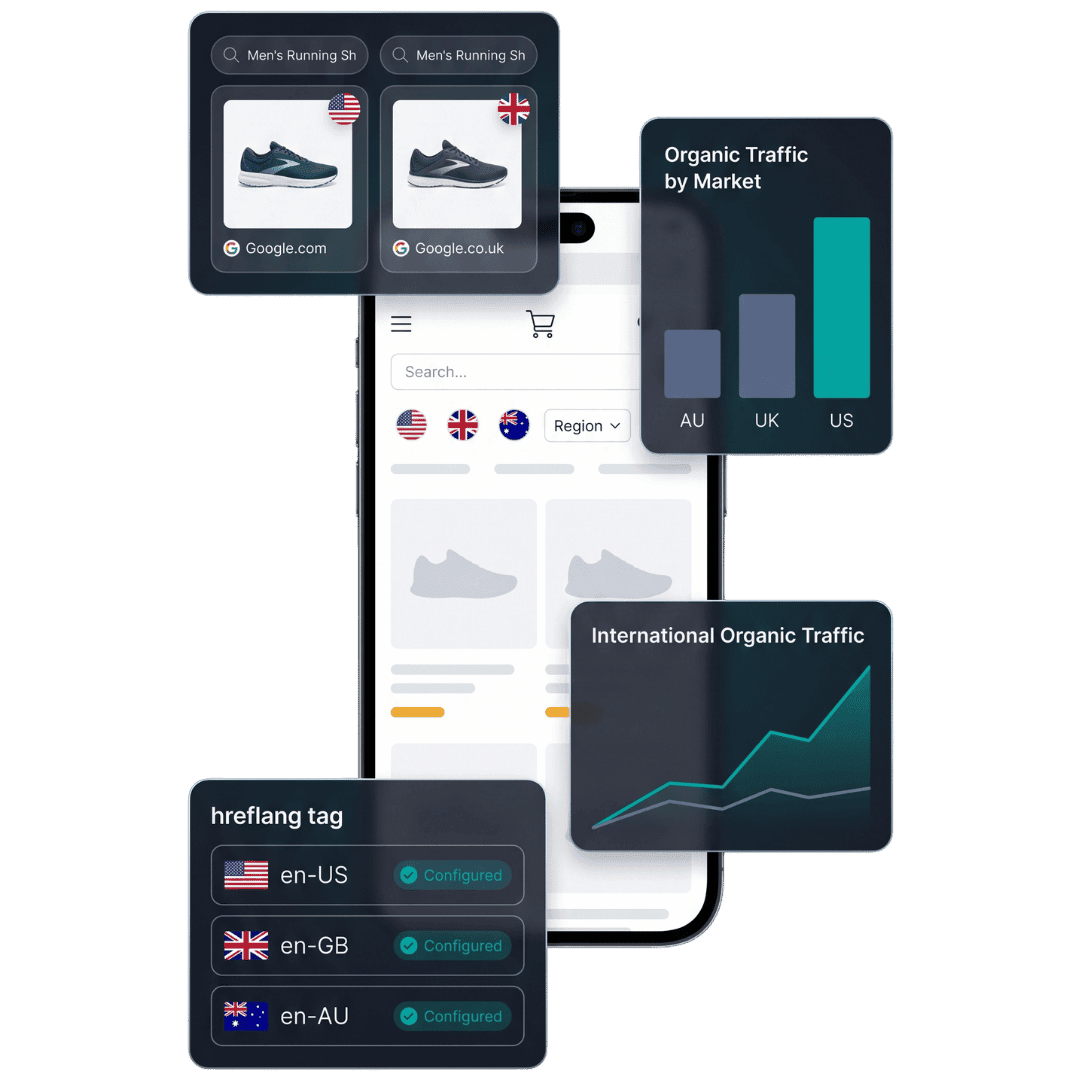
Hreflang tags tell search engines which version of a page to show in which country and language. When they’re wrong, or absent, Google serves the wrong version to the wrong audience. Your UK customers land on US pricing. Your Australian pages get outranked by your US pages. Fixing hreflang after the fact is harder than getting it right from the start, and most ecommerce platforms make implementation more complex than it needs to be.
What international ecommerce SEO covers
International SEO for ecommerce stores goes beyond translation. It’s the technical, structural, and content work that makes your store rank in each target market without undermining performance in your primary one. Every tactic below is built around the specific challenges of selling across borders online.
International site structure strategy
The biggest decision in international SEO is how to structure your site for multiple markets. Country-code top-level domains (ccTLDs), subdirectories, or subdomains: each approach has trade-offs for authority, cost, and management complexity. I analyze your store’s current setup, growth plans, and platform constraints to recommend the structure with the strongest ranking foundation for each target market, covering URL strategy, domain consolidation, and migration planning if your current setup needs to change.
Hreflang auditing and implementation
Hreflang is the mechanism that tells search engines which page to serve in which country and language. It’s also one of the most error-prone elements of international SEO. Wrong return tags, missing self-referencing entries, conflicting signals from canonical tags: any of these can cause Google to ignore your hreflang entirely. I audit existing implementations for errors, build correct hreflang mappings from scratch when needed, and set up validation processes so new pages and products get the right tags automatically.
Multi-market keyword research
Keywords don’t translate. What ranks in one market may have zero volume in another, and the commercial intent behind similar terms often differs between countries. I research keywords market-by-market, identifying the terms local customers actually search for rather than translating your existing keyword list. The output is a separate keyword strategy for each target market, mapped to product pages, category pages, and supporting content, with search volume and commercial intent assessed market-by-market rather than assumed from your primary market.
Localized content and multi-language SEO
Localization goes beyond language. Product descriptions, category page copy, and supporting content need to reflect local search behavior, buying habits, and cultural context. For English-speaking markets like the US, UK, and Australia, this means adjusting terminology, spelling conventions, pricing formats, and product references. For multilingual markets, it means native-language content rather than machine translations, multi-currency display, language selector setup, and correct indexing of each language version.
International technical SEO
The technical requirements for international stores go beyond hreflang. CDN configuration for page speed across regions, server location considerations, correct canonical setups that don’t conflict with hreflang, structured data for multi-region product availability, and making sure each market version is properly crawlable and indexable. I audit and fix the technical layer so search engines understand your international setup and can rank each version in the right market.
International link building and digital PR
Domain authority in one country doesn’t automatically transfer to another. If your US store has a strong backlink profile but your UK version has almost none, your UK pages will struggle to compete against established local competitors. I build market-specific link acquisition strategies: identifying relevant publishers, media outlets, and industry sites in each target country, then running outreach campaigns that earn backlinks from domains that carry authority in that market.
The output is an international SEO strategy that treats each market as its own competitive landscape while keeping your overall site structure clean, efficient, and free of cross-market conflicts.
How it works
01
International SEO audit
A full audit of your store’s international setup: site structure, hreflang, market-level keyword positioning, content gaps, and competitor analysis across each target market. You get a clear picture of what’s working, what’s broken, and the biggest growth opportunities.
02
Market-by-market strategy
Based on the audit, I build an international SEO strategy with separate priorities for each target market. This covers site structure recommendations, keyword targets by country, content requirements, technical fixes, and a phased rollout plan if you’re entering markets sequentially.
03
Full-stack implementation
The strategy gets executed: hreflang fixes, site structure changes, localized content, technical configuration, and market-specific link building, all delivered in priority order. For platform-specific work, the approach is tailored to how your platform handles multi-region setups.
04
Market-level reporting
Monthly reports broken down by market. Rankings, organic traffic, and revenue tracked separately for each country so you can see exactly how each market is performing. Reporting shows what was done, what changed, and where the strategy needs to adjust based on real data.
Who this is for
International SEO is the right investment when your store is selling (or preparing to sell) across borders and organic search in those markets isn’t pulling its weight. It’s not the right fit for every situation.
This is right for you if:
This probably isn’t right for you if:
Related services
International SEO works best when your store’s broader SEO foundation is solid. These services handle the other pieces.
Ecommerce
SEO Audit
Not sure if international SEO is your biggest gap? An audit looks at the full picture, including your international setup, and tells you where to invest first. For stores already selling across borders, the audit includes a market-by-market breakdown of performance and opportunities.
Technical SEO for Ecommerce
International SEO adds a layer of technical complexity on top of standard ecommerce SEO. If your store has crawl issues, indexation problems, or page speed issues in your primary market, those problems multiply across every international version. Technical SEO fixes the foundation first.
Ecommerce Content Strategy
Localized content is half of international SEO, but it needs to sit within a broader content strategy. If your store lacks a coherent content plan for your primary market, adding international content on top will compound the problem rather than solve it.
International SEO implementation is platform-specific. Shopify, WooCommerce, Magento, BigCommerce: every platform handles multi-region setups differently, and your strategy needs to account for those constraints.
Frequently asked questions
Ready to grow organic revenue in new markets?
Book your free ecommerce SEO audit. You’ll see how your international setup compares to competitors in each target market and where the biggest opportunities are to capture organic traffic across borders.
Typically responds within 24 hours.