
BigCommerce SEO Specialist
BigCommerce gives your store strong SEO foundations out of the box. Turning those foundations into organic revenue growth takes a strategy built around your catalog, your market, and how BigCommerce actually works. That’s what I do.
246% organic traffic growth for a fashion brand.
68% increase in organic revenue for a health store.
BigCommerce SEO problems you’ve probably run into
Your BigCommerce store looks fine, but organic traffic isn’t growing
BigCommerce handles a lot of SEO basics for you: clean URLs, automatic sitemaps, CDN-delivered pages, built-in redirects. But those foundations haven’t translated into organic revenue. The issue usually isn’t your store’s setup. No one has built an SEO strategy on top of those foundations, one that targets the right keywords and connects your products to what people search for.
You’ve configured the built-in SEO settings, but rankings haven’t moved
You’ve customized your URLs, written meta titles and descriptions, and set up your product details. Rankings stayed flat. BigCommerce’s built-in SEO tools handle the technical basics well, but they can’t build a keyword strategy, fix your site architecture, or tell you which content to create next. The platform gives you the controls. What’s missing is the strategy behind them.
You’re not sure if BigCommerce is limiting your SEO potential
Maybe someone suggested switching to Shopify or WooCommerce for better SEO. Maybe you’ve noticed competitors on other platforms outranking you. In most cases, the platform isn’t what’s holding you back. BigCommerce has the SEO capabilities to rank well. What’s typically missing is a strategy that takes advantage of them. An audit usually makes the difference clear within a few weeks.
Common SEO issues I find on BigCommerce stores
Most BigCommerce SEO problems aren’t unique to the platform. Thin product pages, missing keyword targets, weak backlink profiles: these show up on every ecommerce site. But BigCommerce does have specific patterns that appear consistently in audits, especially around how the platform handles product filtering, content management, and third-party integrations. Here’s what I typically look for.
Category pages with no keyword strategy
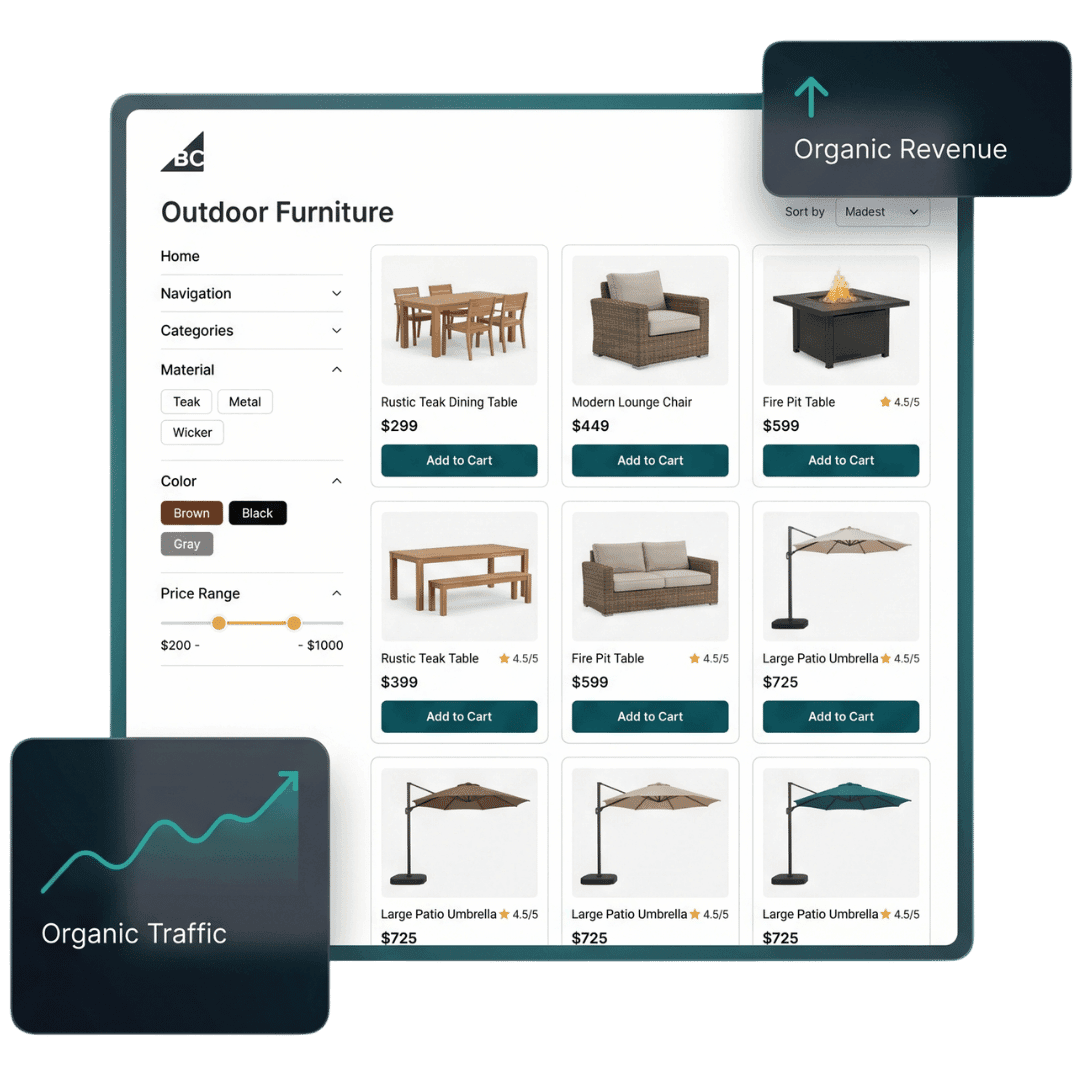
Category pages are your highest-value pages for organic search. Commercial queries like “premium coffee beans” or “outdoor furniture sets” land on category pages, not individual products. But most BigCommerce stores treat categories as product grids with a title and little else. No targeted copy, no keyword focus, no internal links pointing authority to them. Building these pages into proper SEO assets is usually the fastest path to organic revenue growth.
A blog setup that undermines your SEO
BigCommerce’s native blog is more limited than what WordPress or Shopify offer. By default, it can sit on a subdomain rather than a subfolder, which means blog content builds authority for a separate domain instead of your main store. The formatting and internal linking tools are basic. Some stores skip blogging entirely, others publish content disconnected from the catalog. A proper content plan routes traffic toward the pages that generate revenue.
Faceted search creating crawlable low-value URLs
BigCommerce’s product filtering lets shoppers narrow results by brand, price, size, color, and other attributes. Each filter combination can generate a separate URL that search engines try to crawl and index. For stores with thousands of products and multiple filterable attributes, low-value URLs add up fast. Most contain near-identical content and dilute the authority of your category and product pages. Managing crawl access to these URLs is one of the first things I check.
Page speed issues from apps and third-party scripts
BigCommerce stores accumulate third-party apps and tracking scripts over time. Each one adds code that affects page load times and Core Web Vitals scores. The platform’s built-in CDN handles baseline performance well, but app bloat and unoptimized images can undo those gains. I identify which scripts are contributing to slowdowns and prioritize changes by their impact on both rankings and customer experience.
Missing or incomplete structured data
BigCommerce includes basic product markup by default, but it’s often missing fields that help your products stand out in search results: review data, availability status, pricing details. Beyond products, most BigCommerce stores lack FAQ schema, breadcrumb markup, and article schema on blog content. Rich results earn more clicks than plain listings at the same position. I audit what’s in place and recommend what needs adding to give your pages the best chance of earning them.
No visibility in AI-powered search
Google’s AI Overviews, ChatGPT, Perplexity, and other AI search tools are changing how people discover and research products online. If your store’s content isn’t structured for these platforms, you’re missing a growing source of traffic and brand visibility. I assess how your BigCommerce store appears in AI-generated answers and build recommendations into your SEO strategy so you’re positioned for both traditional search and AI-powered discovery.
SEO services for BigCommerce stores
Ecommerce
SEO Audit
A full audit of your BigCommerce store’s SEO: technical health, keyword positioning, content gaps, backlink profile, competitor analysis, and AI visibility. Every finding is prioritized by revenue impact and delivered as a clear action plan with specific next steps.
Technical SEO for Ecommerce
Identifying and prioritizing the technical issues affecting how search engines crawl, index, and rank your BigCommerce store. From product filtering and URL management to page speed and indexation, you get a prioritized action plan tailored to how BigCommerce works.
Ecommerce Content Strategy
A content plan built around the commercial keywords your BigCommerce store should rank for. Category page copy briefs, product page optimization priorities, blog topics that drive traffic toward your money pages, and a publishing calendar to keep it all moving.
Need help with off-page SEO or selling across borders? Link building and international SEO services are also available for BigCommerce stores.
How it works
01
Audit
It starts with an SEO audit of your BigCommerce store. I review your technical setup, keyword positioning, content, backlink profile, and competitive landscape. You get a clear picture of where your organic opportunities are, what’s holding your store back, and what to prioritize first.
02
Strategy
Based on the audit findings, you receive a tailored SEO strategy covering priorities, timelines, and expected outcomes. Every recommendation accounts for how BigCommerce works, so nothing in the plan requires switching platforms or guesswork about what to do next.
03
Execution
The strategy gets implemented. I handle the SEO direction: keyword research, content briefs, on-page optimization plans, and ongoing priorities. Every recommendation comes with clear instructions so implementation stays on track and nothing gets lost in translation.
04
Reporting
Clear monthly reports showing what was done, what changed, and what’s next. Rankings, organic traffic to category and product pages, and revenue from organic search. No vanity metrics. Everything ties back to the keywords and pages that drive revenue for your store.
Who this is for
BigCommerce SEO is the right investment when your store has products worth ranking for and you want organic search to become a reliable revenue channel. It’s not the right fit for every situation.
This is right for you if:
This probably isn’t right for you if:
Frequently asked questions
Ready to grow your BigCommerce store’s organic revenue?
Book your free SEO audit. You’ll see where your BigCommerce store’s organic opportunities are, what’s holding you back, and what a focused SEO strategy can do for your revenue.
Typically responds within 24 hours.