
Magento SEO Specialist
Magento gives your store more control over SEO than almost any other ecommerce platform. Making the most of that control takes an SEO strategy built for how Magento and Adobe Commerce actually work, not a generic approach bolted on after launch. That’s what I do.
246% organic traffic growth for a fashion brand.
68% increase in organic revenue for a health store.
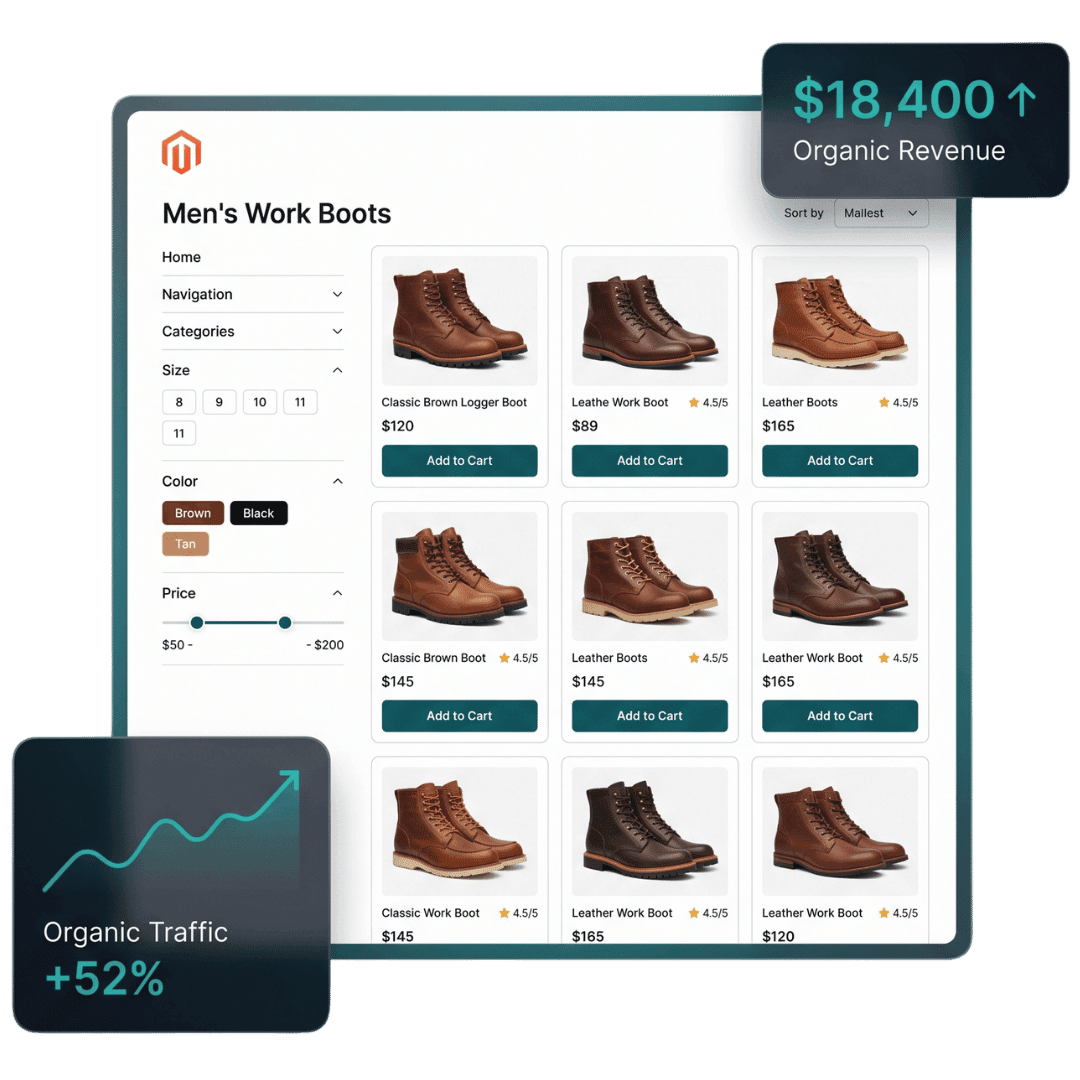
Magento SEO problems you’ve probably run into
You’ve invested in Magento. Traffic hasn’t caught up.
You chose Magento for the flexibility and scale it offers. But that investment isn’t reflected in your organic search performance. The platform can handle complex catalogs, multi-store views, and advanced product configurations, yet Google isn’t rewarding any of it with traffic. The gap is almost always a missing SEO strategy, not a platform limitation.
Technical complexity is making SEO harder than it should be
Magento stores tend to be more technically complex than stores on Shopify or WooCommerce. Layered navigation, configurable products, multiple store views, custom URL structures. All of it creates SEO risks that a generalist approach won’t catch. You need someone who understands how Magento’s architecture affects crawling, indexation, and rankings at the platform level.
You’re not sure if Magento is the problem or the strategy is
Maybe a developer told you Magento is hard to optimize for SEO. Maybe you’ve seen competitors on lighter platforms outranking you. In most cases, the platform isn’t holding you back. The issue is that no one has built an SEO strategy that works with Magento’s strengths instead of fighting against them. An audit tends to identify which it is within the first few weeks.
Common SEO issues I find on Magento stores
Most Magento SEO problems aren’t unique to the platform. Thin product pages, missing keyword targets, weak backlink profiles: these show up on every ecommerce site. But Magento does have specific patterns that appear consistently in audits, especially around crawl management, page speed, and how the platform handles URLs across large catalogs. Here’s what I typically look for.
Layered navigation creating thousands of crawlable URLs
Magento’s layered navigation lets shoppers filter by size, color, price, brand, and dozens of other attributes. Every filter combination generates a URL. For a store with thousands of products and 15 or 20 filterable attributes, the number of crawlable URLs can run into the hundreds of thousands. Most of these pages contain near-identical content and have no business being in Google’s index. Left unmanaged, they waste crawl budget and stop your actual product and category pages from being found.
Category pages built without a keyword strategy
Category pages are where commercial search intent lands. Queries like “industrial safety boots” or “organic baby skincare” point to category pages, not individual products. But most Magento stores treat categories as product grids with a title and nothing else. No targeted copy, no keyword focus, no internal links directing authority to them. They also tend to hold the most ranking potential in any catalog. Building them into proper SEO assets is typically the fastest path to organic revenue growth.
Slow page speed from Magento’s platform overhead
Magento is powerful, but it’s resource-intensive. Without proper optimization, page load times can stretch to four seconds or more. The legacy Luma frontend, heavy extension loads, unoptimized images, and misconfigured caching all contribute. Slow pages hurt both Core Web Vitals scores and conversion rates. I identify what’s dragging performance down and prioritize fixes by impact, so the biggest speed gains come first.
Complex URL structures hurting crawl efficiency
Magento can generate multiple URL paths to the same product when it sits in more than one category. Add URL rewrites, suffix configurations, and internal search result pages to the mix, and you end up with a crawl footprint far larger than it needs to be. Google wastes time on duplicate and low-value URLs instead of focusing on the pages that drive revenue. Cleaning this up is one of the first things I address in an audit.
Missing or broken structured data
Magento includes basic product markup by default, but it’s often incomplete or misconfigured. Review data, pricing details, availability status, and breadcrumb markup are frequently missing or incorrectly implemented. Beyond products, most Magento stores lack FAQ schema, article schema on blog content, and organization markup. Rich results can earn more clicks than plain listings at the same position. I audit what’s in place and recommend what needs adding.
No visibility in AI-powered search
Google’s AI Overviews, ChatGPT, Perplexity, and other AI search tools are changing how people discover and research products online. If your store’s content isn’t structured for these platforms, you’re missing a growing source of traffic and brand visibility. I assess how your Magento store appears in AI-generated answers and build recommendations into your SEO strategy so you’re positioned for both traditional search and AI-powered discovery.
SEO services for Magento stores
Ecommerce
SEO Audit
A full audit of your Magento store’s SEO: technical health, keyword positioning, content gaps, backlink profile, competitor analysis, and AI visibility. Every finding is prioritized by revenue impact and delivered as a clear action plan with specific next steps, each with the reasoning behind it.
Technical SEO for Ecommerce
Identifying and prioritizing the technical issues affecting how search engines crawl, index, and rank your Magento store. From crawl budget management and layered navigation to URL structures and indexation, you get a prioritized action plan tailored to how Magento works.
Ecommerce Content Strategy
A content plan built around the commercial keywords your Magento store should rank for. Category page copy briefs, product page optimization priorities, blog topics that drive traffic toward your money pages, and a publishing calendar to keep it all moving.
Need help with off-page SEO or selling across borders? Link building and international SEO services are also available for Magento stores.
How it works
01
Audit
It starts with an SEO audit of your Magento store. I review your technical setup, keyword positioning, content, backlink profile, and competitive landscape. You get a clear picture of where your organic opportunities are, what’s holding your store back, and what to prioritize first.
02
Strategy
Based on the audit findings, you receive a tailored SEO strategy covering priorities, timelines, and expected outcomes. Every recommendation accounts for how Magento works, so nothing in the plan fights against your platform’s architecture.
03
Execution
The strategy gets implemented. I handle the SEO direction: keyword research, content briefs, on-page optimization plans, and ongoing priorities. Every recommendation comes with clear instructions so implementation stays on track and nothing gets lost in translation.
04
Reporting
Clear monthly reports showing what was done, what changed, and what’s next. Rankings, organic traffic to category and product pages, and revenue from organic search. No vanity metrics. Everything ties back to the keywords and pages that drive revenue for your store.
Who this is for
Magento SEO is the right investment when your store has products worth ranking for and you want organic search to become a reliable revenue channel. It’s not the right fit for every situation.
This is right for you if:
This probably isn’t right for you if:
Frequently asked questions
Ready to grow your Magento store’s organic revenue?
Book your free SEO audit. You’ll see where your Magento store’s organic opportunities are, what’s holding you back, and what a focused SEO strategy can do for your revenue.
Typically responds within 24 hours.