
WooCommerce SEO Specialist
WooCommerce gives your store more flexibility than any hosted platform. Turning that flexibility into organic revenue takes an SEO strategy built around your products, your market, and how WooCommerce actually works. That’s what I do.
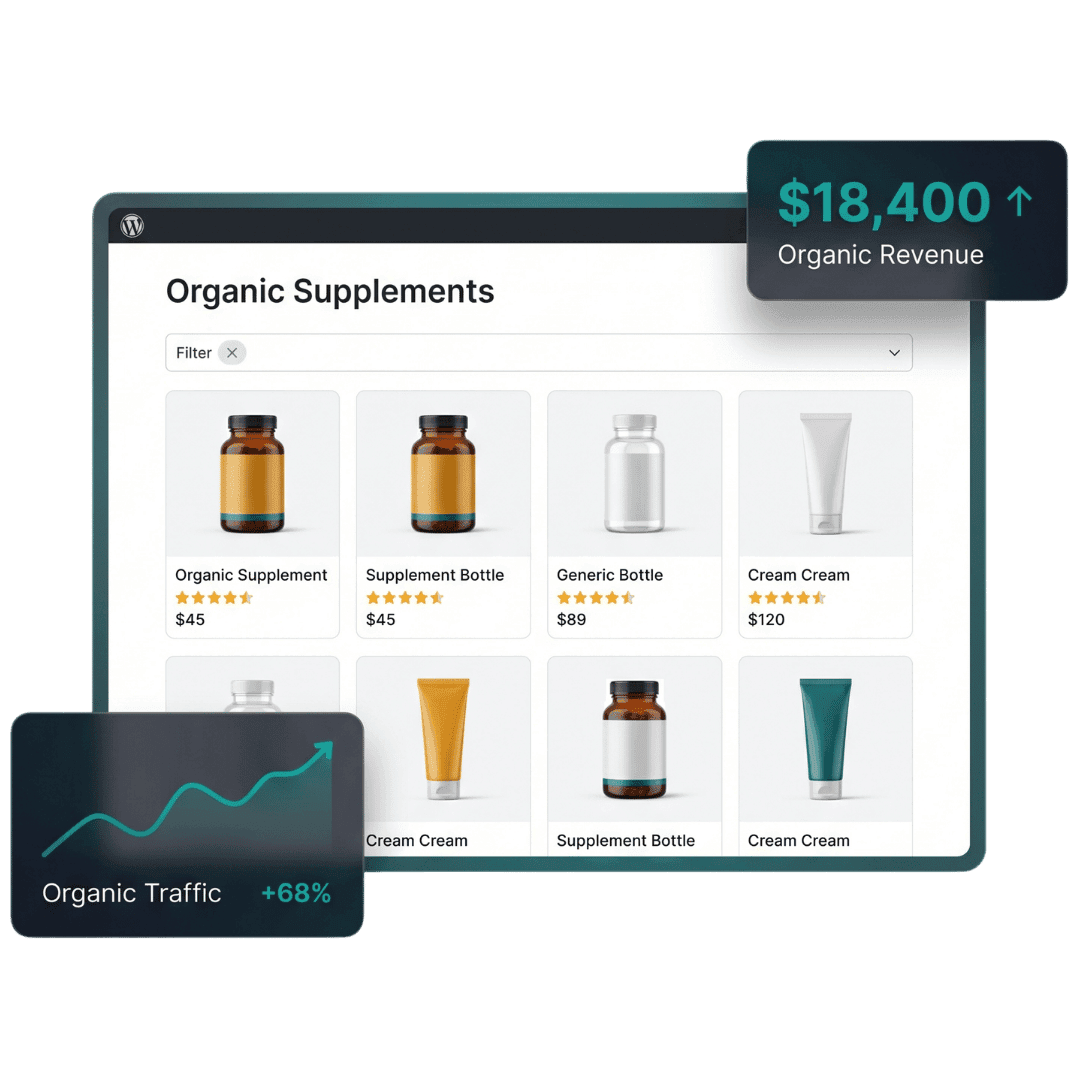
68% increase in organic revenue for a WooCommerce health store.
246% organic traffic growth for a fashion brand.
WooCommerce SEO problems you’ve probably run into
Full control of your store, but organic traffic isn’t growing
WooCommerce gives you the flexibility to build your store exactly how you want. But that control doesn’t automatically translate to organic search performance. Most WooCommerce stores I audit have the same pattern: a well-built store with solid products, but no SEO strategy tying the product catalog, category structure, and content together into something Google can rank.
You’re running an SEO plugin, but rankings haven’t improved
You installed Yoast or RankMath, filled in the meta titles and descriptions, and followed the green-light recommendations. Rankings didn’t move. SEO plugins handle the basics (sitemaps, meta tags, schema), but they can’t build a keyword strategy, fix your site architecture, or identify which pages to create next, and which ones to consolidate. The plugin is the foundation, not the strategy.
Is WooCommerce holding back your organic growth?
Maybe you’ve heard that WooCommerce is slower than hosted platforms, or that WordPress sites are harder to rank. In most cases, the platform isn’t the problem. WooCommerce stores struggle with organic growth for the same reasons any ecommerce store does: no keyword strategy, thin product pages, and no clear SEO direction. An audit makes that obvious early on.
Common SEO issues I find on WooCommerce stores
Most WooCommerce SEO problems aren’t unique to the platform. Thin product pages, missing keyword targets, weak backlink profiles: these show up on every ecommerce site. But WooCommerce does have specific patterns that appear consistently in audits, especially around plugin management, hosting, and how WordPress handles product content. Here’s what I typically look for.
Category pages with no SEO strategy behind them
Your WooCommerce product categories are the pages most likely to rank for high-value commercial keywords. “Organic dog food,” “men’s leather wallets,” “wireless earbuds under $100”: these searches land on category pages, not product pages. But most WooCommerce stores treat categories as simple product grids with a title and nothing else. No targeted copy, no keyword focus, no internal links pointing to them. Building these pages out properly is usually the single biggest organic revenue opportunity.
Variable products creating thin or duplicate content
WooCommerce handles product variations (size, color, material) differently depending on how your store is configured. Some setups create separate pages for each variation with almost identical content. Others consolidate everything onto one page but miss the chance to target variation-specific keywords. I review how your product variations are structured, audit the indexation and content quality of each, and recommend the approach that gives you the best rankings without creating duplicate content issues.
Blog content that exists but isn’t connected to the store
WooCommerce runs on WordPress, so most stores already have a blog. But in many cases, the blog content was written without a keyword strategy and doesn’t link to the products or categories it should support. Posts attract some traffic but none of it converts because there’s no path from the content to a purchase. A proper content plan maps every blog topic to a commercial keyword and connects each post to the right product or category page. That’s what turns a blog from a traffic experiment into a revenue asset.
No visibility in AI-powered search and answer engines
Google’s AI Overviews, ChatGPT, Perplexity, and other AI search tools are changing how people discover and research products online. If your store’s content isn’t structured for these platforms, you’re missing a growing source of traffic and brand visibility. I assess how your WooCommerce store appears in AI-generated answers and build recommendations into your SEO strategy so you’re positioned for both traditional search and AI-powered discovery.
Plugin bloat dragging down your store’s page speed
WooCommerce stores accumulate plugins over time. Each one adds scripts, stylesheets, and database queries that slow your pages down. The result is a store that scores poorly on Core Web Vitals and frustrates both Google and your customers. I regularly audit stores running 30 or more active plugins when they need half that number. Speed improvements start with identifying which plugins are contributing to your store’s performance and which are dragging it down.
Hosting and server performance holding back rankings
Unlike Shopify or BigCommerce, WooCommerce doesn’t come with built-in hosting. Your server setup directly affects page speed, uptime, and how efficiently Google can crawl your store. Shared hosting plans, misconfigured caching, slow database queries, and unoptimized images are all common problems. I identify where your hosting setup is creating SEO bottlenecks and what needs to change so you can make informed decisions about your infrastructure and server configuration.
SEO services for WooCommerce stores
Ecommerce
SEO Audit
A full audit of your WooCommerce store’s SEO: technical health, keyword positioning, content gaps, backlink profile, competitor analysis, and AI visibility. Every finding is prioritized by revenue impact and delivered as a clear action plan with specific next steps.
Technical SEO for Ecommerce
Identifying and prioritizing the technical issues affecting how search engines crawl, index, and rank your WooCommerce store. From plugin performance and server configuration to crawl efficiency and indexation, you get a prioritized action plan tailored to how WooCommerce works.
Ecommerce Content Strategy
A content plan built around the commercial keywords your WooCommerce store should rank for. Category page copy briefs, product page optimization priorities, blog topics that drive traffic toward your money pages, and a publishing calendar to keep it all moving.
Need help with off-page SEO or selling across borders? Link building and international SEO services are also available for WooCommerce stores.
How it works
01
Audit
It starts with an SEO audit of your WooCommerce store. I review your technical setup, keyword positioning, content, backlink profile, and competitive landscape. You get a clear picture of where your organic opportunities are, what’s holding your store back, and what to prioritize first.
02
Strategy
Based on the audit findings, you receive a tailored SEO strategy covering priorities, timelines, and expected outcomes. Every recommendation accounts for how WooCommerce and WordPress work together, so nothing in the plan fights against your platform.
03
Execution
The strategy gets implemented. I handle the SEO direction: keyword research, content briefs, on-page optimization plans, and ongoing priorities. Every recommendation comes with clear instructions so implementation stays on track and nothing gets lost in translation.
04
Reporting
Clear monthly reports showing what was done, what changed, and what’s next. Rankings, organic traffic to category and product pages, and revenue from organic search. No vanity metrics. Everything ties back to the keywords and pages that drive revenue for your store.
Who this is for
WooCommerce SEO is the right investment when your store has products worth ranking for and you want organic search to become a steady revenue channel. It’s not the right fit for every situation.
This is right for you if:
This probably isn’t right for you if:
Frequently asked questions
Ready to grow your WooCommerce store’s organic revenue?
Book your free SEO audit. You’ll see where your WooCommerce store’s organic opportunities are, what’s holding you back, and what a focused SEO strategy can do for your revenue.
Typically responds within 24 hours.