Ecommerce Content Strategy
Most ecommerce stores publish content with no plan behind it. Blog posts that don’t connect to product pages. Category pages with no copy at all. Product descriptions copied from the manufacturer. An ecommerce SEO content strategy fixes all of that by tying every piece of content to the commercial keywords your customers actually search for.
183% increase in category page organic traffic for a home goods store.
246% organic traffic growth for a Shopify fashion brand.
68% increase in organic revenue for a WooCommerce health store.
Why most ecommerce content doesn’t work
Your blog gets traffic but none of it converts
You’ve published blog posts, maybe even consistently. Some of them rank. But when you look at the numbers, the traffic from those posts doesn’t lead to purchases. The posts target informational keywords that attract people who aren’t shopping. Meanwhile, the commercial keywords that drive revenue are going to your competitors.
Your product and category pages are invisible
Most ecommerce stores treat product descriptions as an afterthought. Copy-pasted manufacturer text that ten other retailers also use. Category pages with nothing but a grid of products and no supporting content. Search engines have no reason to rank these pages over anyone else’s because there’s nothing unique on them.
Your content doesn’t connect to revenue
Content gets published when someone has time or an idea. There’s no keyword research behind it, no mapping to buyer intent, no connection between blog content and the product pages it should support. Without a proper strategy, content is a recurring cost. With one, it becomes your most efficient acquisition channel.
What ecommerce content strategy includes
Content strategy for ecommerce isn’t about publishing more. It’s about publishing the right things, on the right pages, targeting the right keywords. Every piece of content connects to a commercial outcome, from product page copy that converts to blog posts that feed traffic into your sales funnel. Here’s what the service covers.
Content audit and gap analysis
Before creating anything new, I audit what you already have. Which pages rank and for what. Which pages have thin or duplicate content. Where your competitors have content you don’t. The gap analysis maps your existing content against the full set of keywords your customers search for, so you can see exactly where the holes are and which ones represent the biggest revenue opportunities.
Keyword research
Not generic keyword research. Ecommerce-specific keyword research that separates commercial intent from informational intent. Product keywords, category keywords, comparison keywords, buying guide keywords, and long-tail variations. Every keyword is mapped to a specific page type (product, category, or blog) based on what Google actually ranks for that query.
Product and category page optimization
These are your money pages. Product descriptions need to be unique, detailed, and written for both search engines and buyers. Category pages need supporting copy that establishes topical relevance and differentiates them from every other store selling similar products. I create optimization briefs for your highest-priority product and category pages.
Blog and editorial strategy
Blog content for ecommerce stores should do one thing: support your product and category pages. Buying guides, product comparisons, how-to content, and informational posts that answer questions your customers ask before they buy. Every blog post is planned with a specific internal linking target, so traffic flows from informational content toward the pages that generate revenue.
Content briefs and publishing calendar
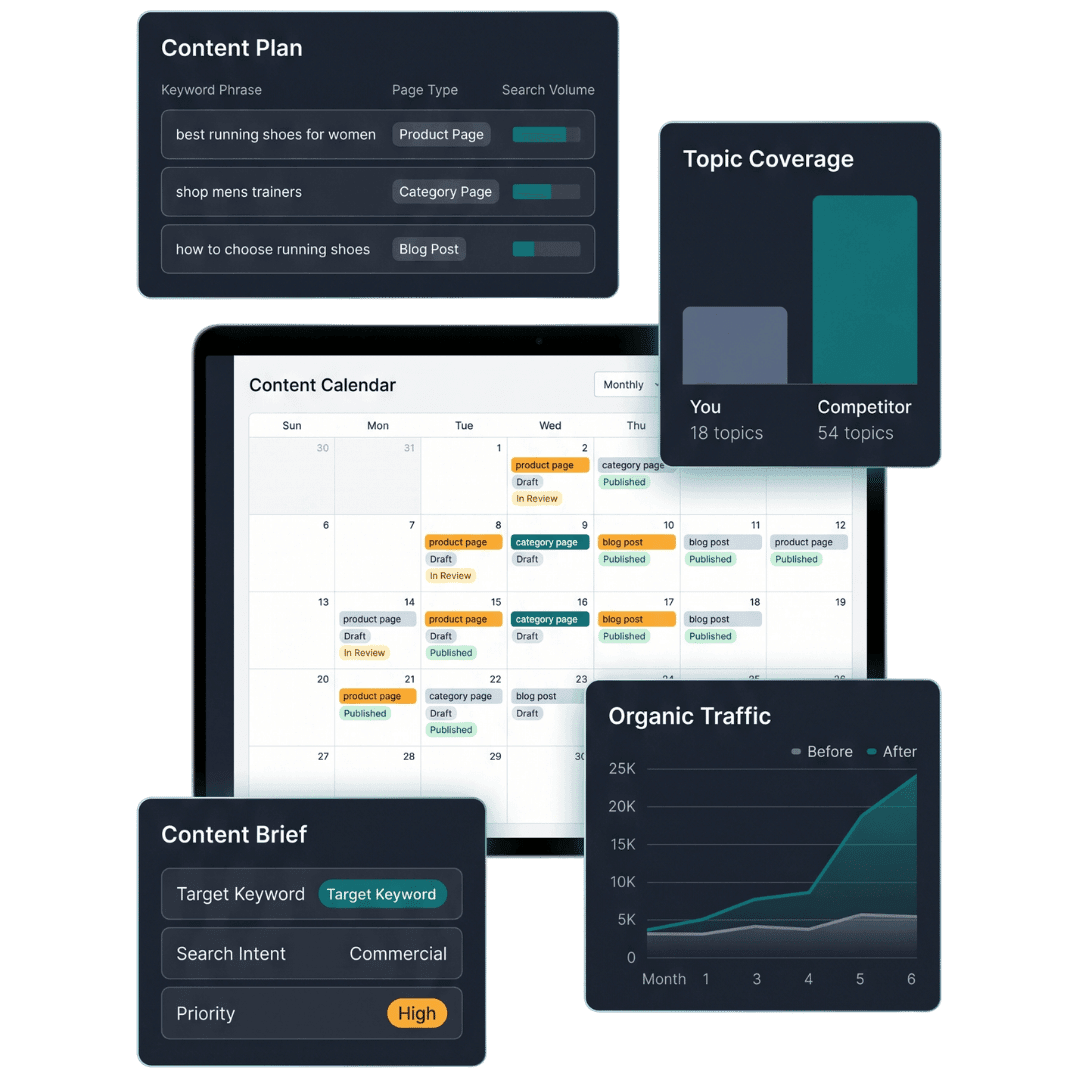
Strategy without execution is a document that sits in a folder. You receive detailed content briefs your writers can follow: target keyword, search intent, recommended structure, word count range, internal linking targets, competitor content to beat, and specific instructions for each piece. These are organized into a publishing calendar with clear priorities and timelines.
AI search optimization
Search is changing. Google’s AI Overviews, ChatGPT, Perplexity, and other AI-powered search tools are reshaping how people find and buy products online. Content structured for AI citation gets referenced in these results. I build AI visibility into your content strategy from the start, so your store is positioned for both traditional rankings and AI-generated answers.
The output is a content strategy that your team (or I) can execute. Every recommendation ties back to commercial keywords and organic revenue. No filler content. No publishing for the sake of publishing.
How it works
01
Content audit
I start by auditing your store’s existing content. What ranks, what doesn’t, and what’s missing entirely. I review your competitors’ content to identify the gaps and opportunities that represent the highest potential return. You get a clear view of where you stand before any new strategy is developed.
02
Strategy and mapping
Based on the audit, I build a keyword-to-content map covering product pages, category pages, and supporting blog content. Every keyword is assigned to a page type and prioritized by commercial value. The strategy is specific to your store, your products, and your competitive landscape.
03
Briefs and calendar
You receive detailed content briefs for each priority piece, organized into a publishing calendar. Briefs include everything a writer needs: target keyword, search intent, structure, competitor benchmarks, and internal linking instructions. For stores that need it, I can handle the content production directly.
04
Measurement
Content is tracked against the keywords it targets. Rankings, organic traffic to specific pages, and revenue attributed to organic search. Monthly reporting shows what’s working, what needs adjusting, and what to publish next. The strategy evolves based on real performance data, not assumptions.
Who this is for
Content strategy is the right investment when your store has products worth ranking for but no plan to make that happen. It’s not the right fit for every situation.
This is right for you if:
This probably isn’t right for you if:
Related services
Content strategy works best when the technical and off-page foundations are in place. These services handle the rest.
Ecommerce
SEO Audit
Not sure if content is your biggest gap or if there are technical issues holding you back? An audit gives you the full picture across your store’s SEO before committing to any specific service.
Technical SEO for Ecommerce
The best content in the world won’t rank if search engines can’t crawl and index your pages properly. Technical SEO fixes the structural foundation so your content has the best chance of performing.
Ecommerce
Link Building
Strong content attracts some links naturally, but competitive ecommerce niches need proactive link building to push product and category pages higher. Good content ranks faster with links.
Content strategy is tailored to your platform. Shopify, WooCommerce, Magento, BigCommerce: every recommendation accounts for your platform’s content management capabilities and constraints.
Frequently asked questions
Ready to turn your store’s content into a revenue channel?
Book your free ecommerce SEO audit. You’ll see exactly where your content gaps are, which keywords your competitors are capturing, and what a focused content strategy can do for your organic revenue.
Typically responds within 24 hours.