Case study · Shopify · Australia
Shopify SEO Case Study:
22% More Organic Revenue in 12 Months
When I took over SEO for this Australian women’s health apparel brand in March 2024, I started with the pages people buy from. Eight months later, the store had its best month for organic revenue in more than two and a half years.
The Project
Store | Women’s health apparel brand |
Platform | Shopify |
Main market | Australia |
Size | Seven-figure annual revenue |
Started | March 2024, ongoing |
My role | SEO strategy and direction |
Work covered | Collection pages, product pages, blogs, link building, reporting, and other optimizations |
The results
+22%
organic revenue in the first 12 months
Google Analytics. March 2024 to February 2025 vs. the previous 12 months.
+109%
non-brand clicks from Google
Google Search Console, Australia. June to August 2026 vs. the same months in 2025
2.4x
growth in organic revenue vs. store’s total revenue
Google Analytics. March 2024 to February 2025 vs. the previous 12 months.
Results vary by store, market, and starting position.
An established brand with more room to grow in search
The brand already had a following. People searched for it by name, and its best-selling product brought in a large share of organic sales.
In the year before I started, almost 70% of Australian organic sales came through just three pages: the homepage, one collection page, and one product page. That product page alone accounted for about a third.
The opportunity was in the searches beyond the brand name. Two of the biggest product searches in the category, each with around 2,500 estimated searches a month, had no collection page built for them.
The store already sold the products. It needed pages that matched how people were searching for them.
What I focused on and why
The collection gaps were the first priority, followed by the best-selling product pages. Articles and link building supported the wider plan to reach more of the searches customers were making.
Two big searches, two new collection pages
Someone searching for a type of product needs a page where they can see the options. For these two searches, the store had no collection bringing the relevant products together.
Two new collection pages went live in March 2024, alongside a rewrite of the main collection page. Both new pages have brought in organic sales since launch.
Giving the best-selling product pages attention early
With one product page bringing in about a third of Australian organic sales, the bestsellers were an obvious place to focus. These were pages where improvements could make a difference to revenue.
The two top-selling product pages were rewritten in May 2024.
Answering the questions that come before a purchase
Product searches were one part of the plan. There were also people researching their options, looking for answers before deciding what to buy. The article topics came from those questions.
Nine articles were published between June and November 2024. Another 19 followed between October 2025 and June 2026, giving the store more opportunities to get found during that research.
Building links from relevant websites
Link building started in March 2024, alongside the collection work. The focus was guest articles on parenting and women’s health websites, with subjects relevant to the products.
The first seven links were placed by July 2024. By August 2026, 24 were live, including links from three Australian parenting sites.
March 2024
Two new collection pages created, main collection rewritten, and link building started
May 2024
Top two product pages rewritten for search
Jun to Nov 2024
Nine articles published on what customers search before buying
Oct 2025 to Jun 2026
Another 19 articles published across 9 months
By August 2026
24 links live from parenting and women’s health websites
How the numbers moved
More revenue from about the same number of visits
Over the first 12 months, organic revenue grew 21.7%. On average, each organic visit brought in about 26% more revenue than the year before.
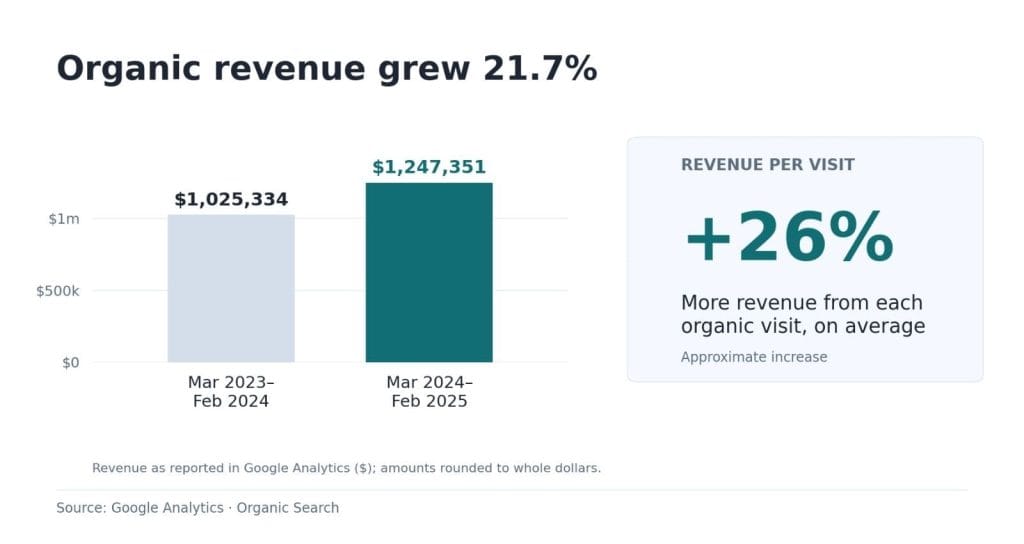
By November 2024, the store had its strongest month for organic revenue since March 2022. That was eight months into the work.
Sources: Google Analytics. Annual comparison: March 2024 to February 2025 vs. the previous 12 months.
Top-three rankings across 48 product and category searches
In August 2026, the store ranked in the top three for 48 of the 53 non-brand product and category keywords tracked. For 47 of those keywords, it held the number-one spot.
These were searches for what the store sells, giving it a strong presence when shoppers were looking for products in its category.
Sources: Google Australia rank tracking, August 2026. Figures cover a defined set of 53 tracked non-brand keyword phrases, including close variants. Exact search terms are withheld to protect the client’s identity.
Clicks from searches without the brand name more than doubled
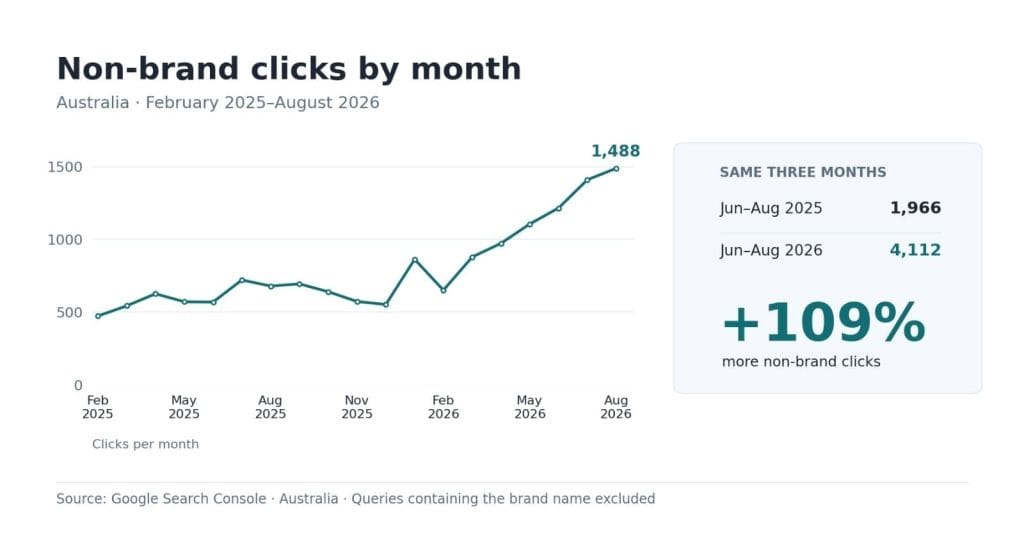
From June to August 2026, non-brand searches brought in 4,112 organic clicks in Australia, up from 1,966 in the same three months of 2025. That’s a 109% increase.
The monthly figures show how that growth built through 2026. Clicks rose every month from March to August, from 878 to 1,488.
For a store with an established brand following, that was a useful sign of progress: more clicks from searches that didn’t mention its name.
Source: Google Search Console, Australia, excluding queries containing the brand name.
Why I tracked non-brand searches separately
The store ran ads on its brand name in December 2025 and resumed them in February 2026. Shopping ads started in January 2026.
Once brand ads are running, someone searching for the store may click an ad where they would previously have clicked an organic result. That can change which channel gets credit for the visit and sale.
Tracking non-brand organic clicks separately helped show how the store was doing beyond searches for its name. Those clicks continued to grow after the ad campaigns started, more than doubling year over year in June to August 2026.
“Within a year, organic search was bringing in more than half of our revenue. If you run a Shopify store and you’re not sure where your SEO budget should go, this is who I’d call.”
Marketing Manager, Australian women’s health apparel brand
What this means for your store
Start with the pages people buy from
On this store, two missing collections and the existing bestsellers gave me a clear starting point. Your store may have a similar opportunity: products people search for, with no useful collection page to land on.
Check which categories your customers search for and whether each has a page that helps them shop. My guide to Shopify collection page SEO covers what I’d look at next.
Write for the questions customers ask before they buy
The articles in this project were planned around those questions. That gives each piece a reason to exist and a natural connection to what the store sells.
For your own content plan, start with what customers need help choosing or understanding. Answer that well, then link to the collection or product that helps them take the next step.
Track searches beyond your brand name
Branded searches tell you how people find you when they know your name. Non-brand searches help you see where you’re getting found for what you sell and the questions your content answers.
Keep both in your reporting, alongside revenue. If you’re running brand ads, review paid and organic results together so you can see the bigger picture.
For this store, the first year brought 22% more organic revenue without more traffic. That’s why I start Shopify SEO work by looking at the pages that sell and the searches the store should be showing up for.
Ready to grow your store’s
organic revenue?
Get a free SEO audit and I’ll show you where I’d start: which pages need attention, which searches you’re missing, and what to fix first.
Typically responds within 24 hours.